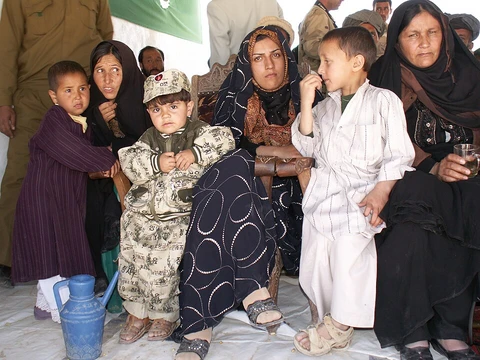
Child
A human between birth and puberty, with fewer rights than adults.

Alberto .... · CC BY 2.0
A child is a human being between the stages of birth and puberty, or between infancy and puberty. The term may also refer to an unborn human being. In English-speaking countries, the legal definition of child generally refers to a minor, a person younger than the local age of majority, regardless of physical, mental, or sexual development. Children generally have fewer rights and responsibilities than adults and are classed as unable to make serious decisions.
- un_convention
- Defined as a human being below age 18 unless majority is attained earlier; ratified by 196 parties, including non-UN member states like the Holy See and Palestine, and by all 195 UN member states exce
Lore & Background
During the European Renaissance, artistic depictions of children increased dramatically, though this did not have much effect on social attitudes. The French historian Philippe Ariès argued that the concept of childhood began to emerge in Europe during the 1600s, but other historians like Nicholas Orme have challenged this view, arguing that childhood has been seen as a separate stage since at least the medieval period. Adults saw children as separate beings, innocent and in need of protection and training. The English philosopher John Locke was influential in defining this new attitude, especially with his theory of the tabula rasa, which considered the mind at birth to be a 'blank slate.'
Reader's Guide
The modern notion of childhood with its own autonomy and goals began to emerge during the 18th-century Enlightenment and the Romantic period. The idea of childhood as a locus of divinity, purity, and innocence is further expounded in William Wordsworth's 'Ode: Intimations of Immortality from Recollections of Early Childhood.' The United Nations Convention on the Rights of the Child, ratified by 192 of 194 member countries, defines a child as a human being below the age of 18 unless majority is attained earlier, providing a widely accepted international legal standard.
Did You Know?
- The term 'child' may also refer to an unborn human being.
- In Singapore, a child is legally defined as someone under age 14 under the Children and Young Persons Act, while the age of majority is 18.
- The United Nations Convention on the Rights of the Child defines a child as a human being below age 18 unless majority is attained earlier; it has been ratified by 196 parties, including non-UN member states like the Hol
- During the European Renaissance, artistic depictions of children increased dramatically, but this did not have much effect on social attitudes toward children.
Strategic Alliance and Social Bonding
Milk kinship functioned as a powerful tool for forging durable bonds between families of unequal standing, creating what scholars describe as an intimate relationship that went beyond blood ties. The practice was remarkably inclusive in its social reach—class boundaries and hierarchical structures did not bar participation, making it a mechanism available across the full spectrum of a community. At the lower end, peasant women who served as wet nurses to children of higher-status families secured the goodwill of their masters and their spouses. Their own offspring became milk-brothers and milk-sisters to the nursed child, creating a network of obligation that could prove strategically valuable over time. At the upper end, noble families deliberately placed their children with status subordinates to be raised to maturity, building a cadre of loyal bodyguards bound by the milk-kin tie. This was a particularly prominent practice in Hindu Kush society. The bond also served a practical survival function: when mothers fell ill or died in childbirth, or when war devastated families, the milk-kinship link provided a ready framework for co-parenting and community support.
Theoretical Debates and Scholarly Controversies
The intellectual history of milk kinship is marked by significant scholarly disagreement. Soraya Altorki's 1980 article was a pioneering effort to examine Sunni Arab notions of kinship created through suckling, noting that anthropologists had largely overlooked the practice despite its recognized weight in Muslim family law as a complex impediment to marriage. Her work opened the door to further fieldwork across Islamic Asia and North Africa. A more controversial thread emerged through Héritier's somatic thesis, which proposed that the prohibition on marriage between milk kin stemmed from an ancient pre-Islamic belief that breast milk was essentially transformed male semen. Several French ethnographers of the Maghreb endorsed this reading. However, Peter Parker critically interrogated this supposition, arguing it was unsubstantiated by current ethnographies and unwarranted as an explanation for the juridical reckoning of milk kinship. Islamic jurists like Al-Qurtubi explicitly rejected the analogy, stating that milk is the property of woman alone and should not be conflated with male semen through qiyas. The debate remains unresolved.
Religious Law and Marriage Prohibitions
Milk kinship carried profound legal and religious weight across multiple faith traditions. In Islamic jurisprudence, the bond created through suckling functioned as a canonical impediment to marriage, a rule that applied through a standard of adoptive kin relations in Sunni law. The prohibition was not limited to one community; Parkes notes that several Eastern Christian churches also endorsed milk kinship as a canonical barrier to marriage, indicating the practice's widespread adoption across the early modern Mediterranean. In the fifteenth century, Christian Canon Law introduced prohibitions against marrying anyone suspected of being a relative, extending the restriction to those who shared godparents, great-grandparents, and even natural or foster parents. The underlying logic was that both biological and spiritual parents held an investment in a child's well-being that marriage between their offspring would violate. Scholars frequently draw parallels between milk kinship and Christian godparenthood, describing both as fictitious kinship relationships between people of unequal status, embedded in long-term exchanges of goods and services known as patronage.
Cross-Cultural Parallels and Practices
The practice of milk kinship was not confined to a single region or religious tradition. While it predates the early modern period, it became a widely used mechanism for developing alliances in many hierarchical societies during that era. The core mechanism was consistent: a wet nurse from the same or a neighboring community breastfed a child, and in doing so, played a strategic role in forging relations between her own family, the child's family, and their respective communities. People of different races and religions could be strategically brought together through the bonding of the milk mother and her milk children. The practice appeared in Hindu Kush society, where noble offspring were sent to fosterers of lower status; in the early modern Mediterranean, where it was endorsed by multiple Christian churches; and across Islamic Asia and North Africa, where it became a culturally distinctive institution of adoptive affiliation. The universality of the underlying logic—using the intimate act of nursing to create obligations that outlast the nursing itself—suggests a deep human impulse to build social cohesion through bodily connection.
Gallery



Frequently Asked Questions
What is Child in the Family and Kinship encyclopedia?
Child refers to a human being in the developmental window between birth and puberty, encompassing both biological growth and social maturation. The term can also extend to an unborn person in certain contexts.
How is Child legally defined in Family and Kinship?
Legally, a Child is a minor—anyone below the jurisdiction's age of majority—regardless of their physical or mental development. Specific thresholds differ by country, such as under 14 in Singapore or under 21 under U.S. immigration law.
What rights does a Child hold compared to an adult?
A Child generally carries fewer legal rights and responsibilities than an adult and is classified as unable to make serious decisions independently. This distinction shapes their treatment across biological, legal, and social frameworks.
What age threshold does the UN use for Child?
The UN Convention defines a Child as any human being below the age of 18, unless a country's own law sets an earlier age of majority. The convention has been ratified by 192 out of 194 member nations.
Can the term Child apply to someone who hasn't been born yet?
Yes, in some usages the word Child can refer to an unborn human being, extending the concept beyond the moment of birth. This broader application sits alongside the more common definition tied to the period between birth and puberty.
More in Family And Kinship 1-15
Spotted an error? Know more?
This is a living reference — every entry is fact-audited, and reader corrections feed straight into our audit queue. Suggest an edit · See this site's audit record