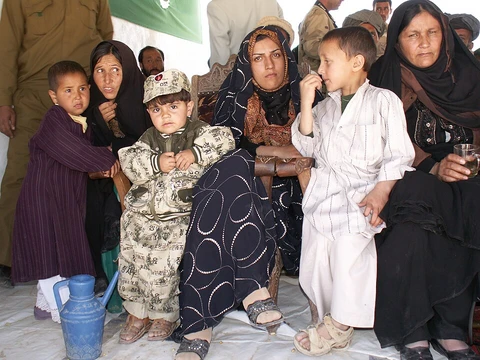
Mother
Female parent of a child, through birth, adoption, or care.

Giles Laurent · CC BY-SA 4.0
A mother is the female parent of a child. A woman may be considered a mother by virtue of having given birth, by raising a child who may or may not be her biological offspring, or by supplying her ovum for fertilisation in the case of gestational surrogacy. The social roles associated with motherhood are variable across time, culture, and social class, and the process of becoming a mother has been referred to as 'matrescence'.
- field
- Parenting, family, social role
- known_for
- Female parent; biological, adoptive, step, surrogate, and other forms of motherhood
- related_terms
- Maternal, mothering, matrescence, mom, mum, mommy, mummy
Lore & Background
A biological mother is the female genetic contributor to the creation of the infant, through sexual intercourse or egg donation. Gestation occurs in the woman's uterus until the fetus is sufficiently developed to be born, typically around 9 months. After birth, the mother produces milk via lactation, which provides antibodies and nutrition for the infant. Childlessness may be voluntary or involuntary, and motherhood may be voluntary or the result of forced pregnancy. Non-biological mothers include adoptive mothers, stepmothers, and 'othermothers' who provide care for a child not biologically their own. Surrogate mothers bear a child from another woman's fertilized ovum. Lesbian and bisexual women may become mothers through adoption, foster parenting, or in vitro fertilization. Transgender women may have biological children using their sperm, but currently cannot carry a child; research on uterus transplants is ongoing. Historically, the role of women was confined to some extent to being a mother and wife. Mothers may be stay-at-home mothers or working mothers. Since the 1970s, in vitro fertilization has made pregnancy possible at ages beyond natural limits, generating ethical controversy. Traditionally, a mother was expected to be a married woman, with birth outside of marriage carrying a strong social stigma, though this has changed in many Western countries.
Reader's Guide
Motherhood encompasses a wide range of biological, legal, and social relationships. The term 'mother' applies not only to the woman who gives birth but also to those who adopt, foster, or serve as stepmothers, as well as surrogate and other-mother figures. The social role of mothers has varied across cultures and time, with expectations ranging from full-time homemaking to participation in the workforce. Advances in reproductive technology, such as in vitro fertilization, have expanded the possibilities for motherhood, including for lesbian, bisexual, and transgender women, while also raising ethical questions. The significance of motherhood lies in its central role in child-rearing, family structure, and societal norms, though these norms continue to evolve, particularly regarding single motherhood and the balance between career and caregiving.
Did You Know?
- The process of becoming a mother has been referred to as 'matrescence'.
- A surrogate mother carries and gives birth to a child that she is not the biological mother of.
- In well-nourished girls, menarche usually takes place around the age of 12 or 13.
- Mothers are more likely than fathers to encourage assimilative and communion-enhancing patterns in their children.
Social Strategy and the Architecture of Alliance
Milk kinship operated as a deliberate instrument of social bonding, linking families of unequal standing through the act of a wet nurse feeding a child. The resulting bond was intimate and durable, effectively stripping a lower-status family of their outsider position while simultaneously barring them from becoming marriage partners. Crucially, this mechanism was not restricted by class, race, or religious affiliation; it could strategically unite people who would otherwise remain in separate social spheres. The wet nurse occupied a pivotal position in this arrangement, as the alliance extended beyond the individual child to encompass her entire family and community. In this way, a single act of nursing could reconfigure the social landscape of multiple households, creating an alternative to blood-based kinship that carried its own weight and obligations. The practice was not merely sentimental—it was a calculated tool for building loyalty and mutual obligation across the boundaries that normally divided communities.
Class Dynamics and the Practical Lifeline of Nursing
The practical and political applications of milk kinship varied dramatically depending on the social position of those involved. For peasant women, nursing a master's child served as a means of securing the household's goodwill, while their own offspring gained the status of milk-brothers and milk-sisters to the noble child—a connection that could prove strategically valuable in later years. In societies where mothers fell ill or died in childbirth, the arrangement also functioned as a lifeline, ensuring the infant survived. During periods of war, when entire families perished, milk-kinship provided a framework for other community members to step in as co-parents. At the opposite end of the social spectrum, noble families in the Hindu Kush region deliberately sent their children to be raised by status subordinates. The intent was explicitly political: by creating a web of milk-kin obligations, the ruling family cultivated a network of loyal bodyguards whose allegiance was bound not by contract but by the intimate, inescapable ties of shared nourishment.
The Somatic Thesis and the Battle Over Origins
Among the most contested interpretations of milk kinship is the so-called somatic thesis advanced by Héritier, which posits that the Islamic prohibition on marriage between milk kin stems from an ancient pre-Islamic belief that breast milk is, in essence, transformed male semen. Héritier argued this reflected a broader somatic scheme of male filiative substances transmitted through lactation, a reading later endorsed by several French ethnographers working in the Maghreb. However, scholars such as Parker have challenged this framework, noting that no credible evidence supports the claim that Arab communities actually held such a folk-physiology. Citing Islamic jurisprudence, commentators like Al-Qurtubi explicitly rejected any analogy between milk and semen, insisting that milk belongs solely to the woman. Soraya Altorki's 1980 article was among the first to draw anthropological attention to the institution, noting its recognized significance in Sunni family law as a complex impediment to marriage. Despite this, the deeper origins of the taboo remain unresolved in modern jurisprudence.
Cross-Tradition Legal Resonance and Spiritual Kinship
Milk kinship did not exist in a single religious or cultural vacuum; it intersected with legal and spiritual frameworks across multiple traditions. In Islamic jurisprudence, the bond created through suckling functioned as a canonical impediment to marriage, a rule that applied through the standard of adoptive kin relations. The practice was not confined to Muslim communities: several Eastern Christian churches similarly endorsed milk-kinship as a barrier to marriage, indicating its widespread adoption across the early modern Mediterranean. In the fifteenth century, Christian Canon Law introduced prohibitions against marrying anyone suspected of being a relative, extending these restrictions to those who shared godparents or great-grandparents. Scholars frequently draw parallels between milk kinship and Christian godparenthood or spiritual kinship, framing both as fictitious kinship bonds between people of unequal status embedded in long-term exchanges of goods and services—what we recognize as patronage. This cross-traditional resonance suggests that the impulse to create non-biological family ties carried profound legal and social weight well beyond any single faith.
Gallery





Frequently Asked Questions
Who is a Mother in the context of family and kinship?
A Mother is a female parent of a child, a role that can be established through giving birth, raising a child who may not be biologically hers, or providing an ovum for fertilisation in a surrogacy arrangement. She occupies the central caregiving and nurturing position within a family unit.
What are the different recognized forms of motherhood?
Motherhood encompasses biological, adoptive, step, and surrogate forms, among others. A woman can be a mother by virtue of carrying and delivering a child, by legally or socially taking on the role of raising a child, or by contributing genetically through a gestational surrogacy.
What is matrescence and how does it relate to Mother?
Matrescence is the term used to describe the transitional process of becoming a mother. It parallels concepts like adolescence but specifically captures the personal, social, and psychological shifts a woman undergoes as she enters the maternal role.
Why is the role of Mother considered important in kinship studies?
Mother is a foundational figure in parenting and family structure, and the social expectations attached to motherhood vary significantly across different cultures, time periods, and social classes. Understanding this role helps explain how societies define caregiving, lineage, and emotional bonds within families.
What are the common related terms and synonyms for Mother?
Frequently associated terms include maternal, mothering, matrescence, mom, mum, mommy, and mummy. These words appear across the fields of parenting, family studies, and social role analysis to describe various facets of the mother's position.
More in Family And Kinship 1-15
Spotted an error? Know more?
This is a living reference — every entry is fact-audited, and reader corrections feed straight into our audit queue. Suggest an edit · See this site's audit record