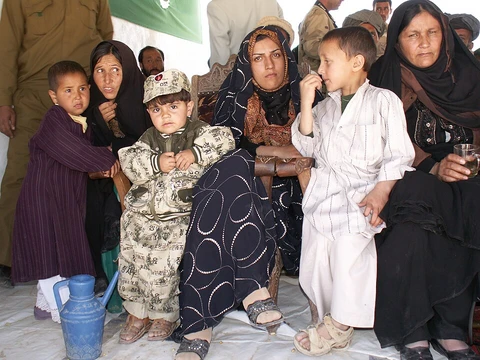
Sibling
A relative sharing at least one parent with another person.

Johnnybam · CC BY-SA 4.0
A sibling is a relative that shares at least one parent with another person. Male siblings are brothers, female siblings are sisters, and a person with no siblings is an only child. Siblinghood is considered a unique type of relationship, often characterized by strong emotional bonds that develop from growing up together, though these bonds can be complicated by factors such as parental treatment, birth order, personality, and personal experiences outside the family.
- full_sibling_relatedness
- 50% (first-degree relative)
- half_sibling_relatedness
- 25% (second-degree relative)
- types
- full-siblings, half-siblings, three-quarter siblings, diblings, stepsiblings, adoptive siblings, foster siblings, god siblings, milk siblings, cross-siblings
- common_type
- full-siblings
Lore & Background
Siblings or full-siblings share the same biological parents and are the most common type. Twins are siblings born from the same pregnancy and generally share a greater bond due to growing up together and being the same age. Half-siblings share one parent and are classified as uterine (maternal) or agnate (paternal) half-siblings; in law, the term 'consanguine' is used for agnate. Three-quarter siblings share one parent while the unshared parents are first-degree relatives to each other, such as when a man has children with two sisters, making the children half-siblings and first cousins. Diblings, or donor-conceived siblings, are biologically connected through donated eggs or sperm but are not legally considered siblings for family rights and inheritance.
Reader's Guide
Sibling relationships are foundational in most societies, as siblings typically grow up together and develop strong emotional bonds that are often complicated by factors like birth order, parental treatment, and personality. Medically, full-siblings are first-degree relatives (50% related), while half-siblings are second-degree relatives (25% related). In practice, full siblings do not share exactly 50% of their DNA due to chromosomal crossover; the mean DNA fraction shared is 50.28% with a standard deviation of 3.68%. Half-siblings can be related as three-quarter siblings (3/8) if their unshared parents are closely related, such as siblings or parent and child. Birth order—typically classified as eldest, middle child, or youngest—is a key factor studied in sibling dynamics. The legal treatment of siblings varies, with half-siblings historically receiving unequal inheritance rights in some jurisdictions, such as Florida, though such inequalities have been abolished in England.
Did You Know?
- Full-siblings share 50% of their DNA on average, but the mean DNA fraction shared is 50.28% with a standard deviation of 3.68%.
- Three-quarter siblings share one parent while the unshared parents are first-degree relatives, such as sisters or parent and child.
- Half-siblings are 25% related by consanguinity, as they share one parent and are separated by two generations.
Definition and Terminology
A sibling-in-law encompasses three distinct relational pathways: the spouse of your own sibling, the sibling of your spouse, or the spouse of your spouse's sibling. While these three routes all converge on the same in-law category, everyday language typically collapses them into the familiar labels of brother-in-law or sister-in-law, depending on the gender of the person in question. However, Indian English preserves a more granular vocabulary for at least one of these pathways. In that linguistic tradition, the spouse of one's spouse's sibling can be called a co-sibling, with further specification into co-sister (the wife of one's sibling-in-law) or co-brother (the husband of one's sibling-in-law). This additional layer of nomenclature reflects a cultural tendency to distinguish between the different routes by which a person enters the family circle, rather than treating all in-law connections as interchangeable. The broader English-speaking world, by contrast, tends to default to the simpler gendered terms regardless of which of the three pathways applies.
Kinship Classification and Complex Family Structures
The sibling-in-law bond belongs to a category of kinship known as affinity, placing it in the same family of relationships as all other in-law connections. What unites these ties is their shared characteristic: none of them connect two people through direct blood descent. Despite this, the family web extends further than the immediate in-law pair. The children of one's siblings-in-law are classified simply as nieces and nephews, though in contexts where precision matters, the qualifier by marriage can be appended to differentiate them from nieces and nephews by blood or by adoption. A particularly intricate scenario arises when one pair of siblings marries another pair of siblings. In that arrangement, each of the four individuals holds a dual in-law status, connected to the others simultaneously through their own sibling and through their spouse. The offspring of those two couples, in turn, become double cousins, a kinship designation that reflects the doubled genetic and relational pathways linking them.
Psychological and Social Dynamics
Research into the emotional texture of family triads has shed light on how sibling-in-law relationships function in practice. One notable study examined the potential for envy within the three-person system formed by a sibling, a sibling-in-law, and a spouse. The findings suggested that the sibling-in-law bond does not exist in a vacuum; rather, it shares meaningful structural similarities with both the spousal relationship and the sibling relationship simultaneously. Furthermore, the study found that relational closeness and satisfaction across all three relationships in the triad were correlated, implying that tension or warmth in one channel tends to ripple into the others. This interdependence underscores that the sibling-in-law is not merely a peripheral addition to the family unit but a node whose emotional health is woven into the broader relational fabric. The triadic nature of these bonds means that no single relationship can be fully understood in isolation from the other two.
Religious and Legal Frameworks
Religious legal traditions have long grappled with the boundaries of permissible intimacy within extended family structures, and the sibling-in-law relationship features prominently in those discussions. In Islamic law (Sharia), sexual relations between siblings-in-law are classified as incestuous and therefore prohibited, with the exception that the restriction lifts if the intervening spouse is no longer alive or the marriage has otherwise ended. Jewish law (halakha) similarly forbids such relations as incestuous under the same condition. However, Jewish tradition also preserved a distinct custom known as yibbum, which placed a non-obligatory duty on a man to marry his deceased brother's childless widow, with the specific purpose of ensuring she could bear progeny in her late husband's name. This practice, while not mandating the union, recognized a social and spiritual obligation to preserve a family line. Together, these legal and religious frameworks illustrate how different cultures have navigated the tension between the closeness of in-law bonds and the boundaries they impose on sexual and marital conduct.
Gallery





Frequently Asked Questions
What is a sibling?
A sibling is any person who shares at least one biological parent with you. The term covers brothers, sisters, and the broader spectrum of sibling relationships defined by shared parentage.
What types of siblings are recognized?
Beyond full-siblings (the most common type), the category includes half-siblings, three-quarter siblings, diblings, stepsiblings, adoptive siblings, foster siblings, god siblings, milk siblings, and cross-siblings. Each type reflects a different configuration of shared or socially assigned parentage.
How genetically related are full siblings to each other?
Full siblings share approximately 50 percent of their genetic material, which classifies them as first-degree relatives. This is the same level of relatedness as between a parent and a child.
How does a half-sibling differ from a full sibling?
A half-sibling shares only one parent rather than two, resulting in roughly 25 percent shared DNA. This places them in the second-degree relative category, one step removed from the 50 percent bond of full siblings.
Why is the sibling bond considered distinct from other family relationships?
Siblinghood is shaped by years of shared household experiences, creating emotional ties that differ from parent-child or spousal bonds. Those bonds can be deepened or strained by factors like birth order, differential parental treatment, personality clashes, and outside life events.
More in Family And Kinship 1-15
Spotted an error? Know more?
This is a living reference — every entry is fact-audited, and reader corrections feed straight into our audit queue. Suggest an edit · See this site's audit record